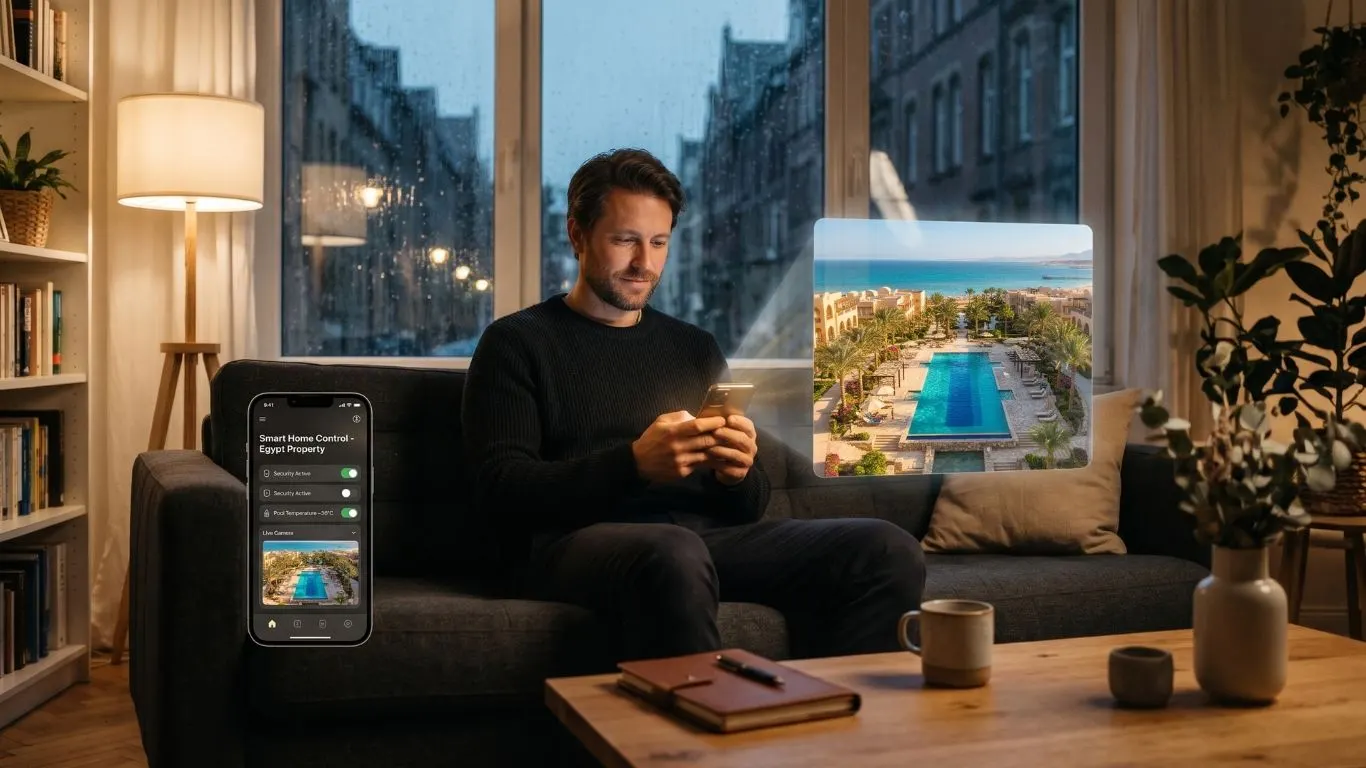
Let us start with an uncomfortable truth about owning a flat abroad: the distance is lovely until something drips. At 11 p.m. on a rainy Tuesday in Manchester, Hamburg or Helsinki, your mind will cheerfully wander to a tap in the Red Sea that may or may not be leaking. Nobody has ever fallen asleep faster by imagining their own bathroom 4,000 kilometres away.
The good news is that owning property in Egypt from Europe no longer means phone calls at odd hours, a cousin of a friend who ‘knows a guy’, or a shoebox of paper receipts. At Forward Development we built our communities in Sahl Hasheesh around a simple idea: if you can check your bank balance from your sofa, you should be able to run your apartment the same way. This guide walks through how remote ownership actually works day to day, from the owner app to the QR gate passes, and what you should demand from any developer before you sign.
The honest problem with owning abroad
Most people who hesitate about buying in Egypt are not worried about the sea, the sunshine or the price per square metre. They are worried about control. Who holds the keys? Who tells me if the air-conditioning breaks? Who lets the plumber in? And, the big one, how do I know what is happening with the money?
Traditionally, the answers have been awkward. A local agent here, a caretaker there, a spreadsheet that only one person understands, and a lot of WhatsApp messages that start with ‘Hello sir, small problem’. It works until it does not, and then you are booking a flight to find out which of those people was actually in charge.
Remote ownership only feels safe when three things are true. You can see what is going on. You can ask for things to be done and track that they happen. And you can let people in and out of your home without handing out copies of your key like party invitations. That is exactly the gap a proper owner app is meant to close.
What the owner app actually does
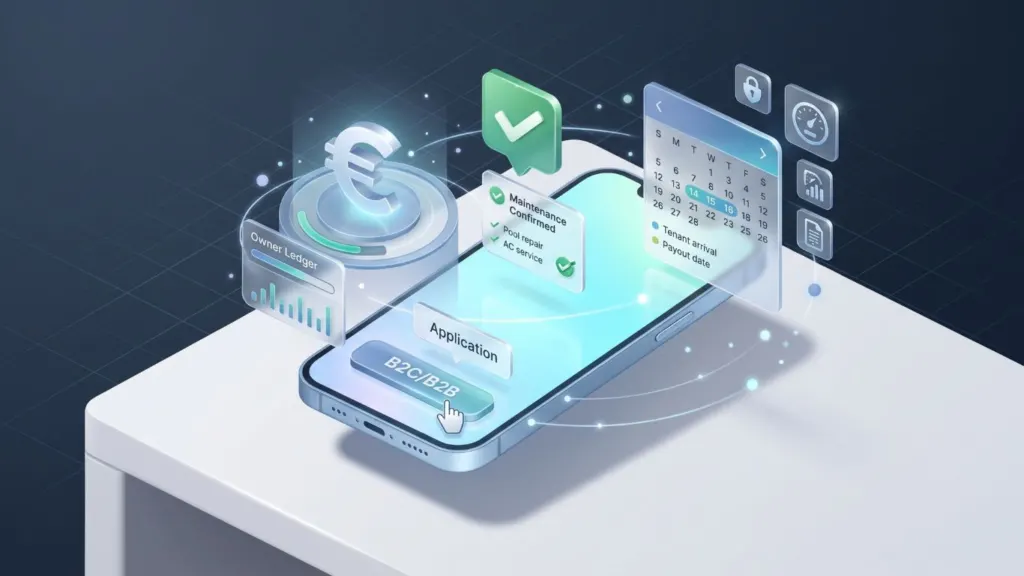
Every owner in our communities gets access to a custom web and mobile app, available in both English and Arabic. It is not a brochure with a login button; it is the control panel for your unit. Here is what you can do with it from wherever you happen to be.
Maintenance tickets: no more ‘did you get my message?’
Something needs fixing? You open a maintenance ticket from your phone, describe the issue and send it to the management team. The point of a ticket, as opposed to a text message, is that it exists. It has a status, a history and a name attached to it. Nobody can say they never saw it, and you can check progress without sending a polite chaser at breakfast time.
If you have ever tried to resolve a boiler problem in a foreign country through three different people and a voice note, you will appreciate how boring a good ticket system is. Boring is exactly what you want from your plumbing.
Rent notices: keeping everyone on the same page
If you plan to let your apartment, you can submit a Rent Notice through the app, so the management team always knows what is happening with your unit. No emails lost in a spam folder, no ‘I thought you told Ahmed’. One place, one record, one version of the truth.
Financial ledgers: your numbers, in euros
The third piece is the one that lets people sleep: a financial ledger you can open at any time. Property prices, contracts and ledgers at Forward Development are displayed and pegged in euros, so what you see on screen is what you actually agreed to, without mental arithmetic involving the Egyptian pound. If you want to understand why we do it this way, our article on euro-priced property in Egypt and currency risk goes into the detail, including what the peg does not cover.
Seeing payments, balances and charges in one place also makes your annual admin pleasantly dull. If you are comparing the cost side with the income side, our guide to the cost of buying property in Egypt is a good companion read.
Smart QR gate passes: guests without the key under the flowerpot
Our communities in Sahl Hasheesh are gated, which is wonderful for peace of mind and slightly tricky for visitors. How do you get your sister, your tenant, or the man who is servicing the air-conditioning past the gate when you are in another country?
The answer is a dynamic, temporary QR code. From the app, you generate a pass for a specific guest or tenant. They show it at the gate, the community stays 100% secure, and the pass is not a permanent key that wanders around the internet for the next ten years. You are not texting a security guard a photo of somebody’s passport at midnight, and you are not hiding a spare key under a plant pot, a practice that Egyptian burglars and British grandmothers have both long since worked out.
For owners who let their apartments, this is a bigger deal than it sounds. Guests arrive, scan, walk in. Departing guests leave, and the pass simply stops being useful. It is the digital equivalent of a very polite doorman who never forgets a face and never takes a day off.
A normal week as a remote owner
It is easier to picture this with a real example. Imagine you are Anna, a teacher in Leeds who bought a one-bedroom apartment in Sahl Hasheesh and plans to use it for two holidays a year.
On Monday morning, between emails, Anna opens the app and notices that the kitchen tap has a slow drip. She files a maintenance ticket with a short description. It takes about as long as buying a train ticket. On Wednesday, the ticket shows as handled and she can see it in the history. No flight, no phone call.
On Thursday, her brother Tom decides to visit in March with his family. Anna generates a temporary QR pass for his dates and sends it to him. When he arrives, he scans at the gate and he is in. Anna did not have to find anyone, translate anything or wake up at 4 a.m.
On Friday evening, she opens the ledger, sees everything in euros, and goes back to her glass of wine. That is the whole point. The best remote management is the kind you barely notice.
When you let it out: in-house management and the two-night rule
Many of our owners prefer their apartment to earn something when they are not using it. That is where in-house property management comes in. The same team that looks after the community handles short-term and Airbnb-style rentals for owners who choose that route, which means one team, one standard and fewer strangers with keys.
We also enforce a strict minimum stay of two nights. That sounds like a small detail, but it is one of the reasons our communities feel the way they do. Fewer one-night turnovers means less wear on the apartment, quieter corridors and a more settled atmosphere for the people who live there for weeks or months. It protects the asset you paid for, and it protects the community around it. If you are weighing up what a holiday-let can realistically bring in, our pages on rental yield in Sahl Hasheesh and property management in Sahl Hasheesh are the places to start.
What an app cannot do (and why that matters)
Let us be sensible for a moment. An app is a tool, not a miracle. It cannot mend a pipe by itself, and it will not make a bad developer good. What it does is make the people behind it accountable and visible. A ticket needs a team to answer it. A ledger needs real accounting behind it. A gate pass needs a community with a real gate.
So when you look at any development in Egypt, or anywhere, treat the software as the shop window and ask what is behind it. Which brings us to a small checklist.
Seven questions to ask any developer before you buy
- Is there an owner portal, and can you see a real demo rather than a slideshow?
- Can you log maintenance requests and see their status and history?
- Are prices, contracts and ledgers shown in a currency you actually think in?
- How do guests and tenants get through the gate when you are not there?
- Who manages short-term lets, and are there minimum stay rules that protect the community?
- Is the app available in a language you and your family can use?
- Are there broker commissions or hidden fees layered on top of the price?
On that last point, our own model is direct from the developer with zero broker commissions and 0% interest payment plans over three to five years, so there is no bank mortgage to arrange. If you are still working out how to pay, our guide to transferring money to buy property in Egypt walks through it step by step.
Planning your first visit
Even the best app does not replace seeing your home with your own eyes, and there are far worse excuses for a trip than a sunny apartment on the Red Sea. When you plan your first visit, check the latest entry information for your passport on the official UK government travel advice for Egypt, or the official Egypt Tourism Authority website, then relax. Plenty of owners tell us that by their second stay they already feel like locals: they know the nearest café, the best time for a swim and which neighbour is secretly the best barbecue cook. If that sounds like your kind of life, our piece on living in Sahl Hasheesh gives you a flavour of it.
See it for yourself at Lana Hills and Panorama View
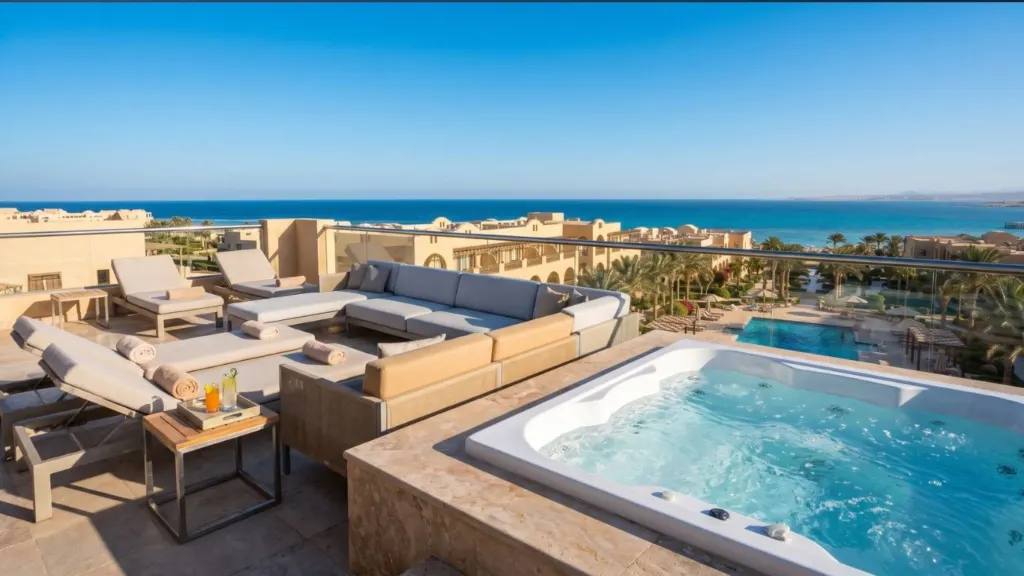
The owner app, the QR gate access and the in-house management team are part of both of our projects. Lana Hills offers villas, sea-view studios and family apartments, while Panorama View offers apartments, penthouses and duplexes with panoramic Red Sea views and private rooftops with jacuzzis. Both come direct from the developer, priced in euros, with payment plans that do not involve a mortgage.
Would you like a walkthrough of the owner app, or to see which unit would suit your plans? Get in touch with the Forward Development team through our website, tell us where you are based and when you would like to visit, and we will show you around, on screen or in person.