Let’s get the awkward bit out of the way: nobody buys a flat on the Red Sea because they are thrilled about tax. You buy it for the sunrise over the water, for the winters you will never again spend in a raincoat, and possibly for the smug pleasure of telling colleagues you are ‘popping to the coast’ in January. Tax is simply the guest who turns up uninvited, like a distant cousin at a barbecue.
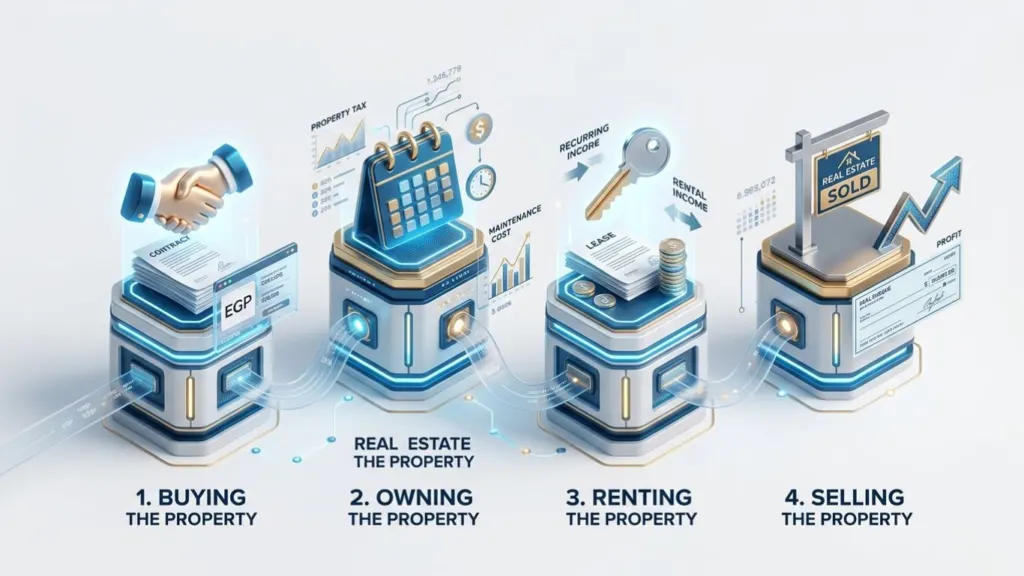
The good news is that property taxes in Egypt for foreigners are far less frightening than the rumours suggest. There are four moments when the taxman takes an interest: when you buy, every year you own, when you earn rent, and when you sell. Each one has a clear rule, and most of them are calculated in a way that works in your favour once you understand it. Let’s go through them one by one, with real numbers instead of vague reassurance.
The four taxes at a glance
| Moment | What applies | Typical rate |
|---|---|---|
| Buying | Notary and legal fees (the 2.5% transfer tax is legally the seller’s) | About 4-5% of the price, paid by the buyer |
| Owning | Annual real estate tax | 10% of the net assessed rental value |
| Renting out | Personal income tax on rent | Progressive, on 50% of gross rent |
| Selling | Real estate disposal tax | 2.5% of the gross sale value |
The figures above follow the breakdown published by Global Property Guide, which tracks Egyptian property taxes for international buyers. Rules do get adjusted from time to time, so the Egyptian Tax Authority’s official website is the place to confirm a rate before you sign anything.
1. When you buy: costs, not a tax bonanza
Here is a pleasant surprise. The headline transfer tax of 2.5% is a seller’s liability, not a buyer’s. What lands on your side of the table is mostly professional fees: roughly 0.5% for the notary and somewhere between 1% and 2% for legal work. Add the usual bits and bobs and Global Property Guide puts the total paid by buyers at around 4-5% of the price.
Compare that with parts of Europe, where a purchase can quietly swallow 10% or more once stamp duty, agents and notaries have all had their slice. On the Red Sea, the number is considerably kinder. Our guides on the full cost of buying property in Egypt and the hidden costs of a Red Sea home go through every line in detail, so nothing ambushes you at the signing table.
One more thing worth knowing: buying directly from the developer means there is no estate agent in the middle, so there is no agent’s commission to add to the pile. At Forward Development it is zero, which is rather the point.
Registration itself is a separate step from tax, and it is what turns a paper promise into properly registered ownership. We cover it step by step in property registration in Egypt.
2. Every year: the annual real estate tax
Egypt charges an annual real estate tax on built property under Law 196 of 2008. The clever bit, and the bit people most often get wrong, is that it is not calculated on what you paid. It is calculated on the net assessed annual rental value, a figure set by the Real Estate Tax Authority, which is a deliberately conservative estimate of what the unit could earn in rent.
The recipe goes like this:
- The authority assesses the annual rental value of your unit.
- A statutory deduction is applied: 30% for residential property (so you are taxed on 70%), 32% for non-residential.
- The tax is 10% of what is left.
A worked example, with made-up but sensible numbers. Suppose the assessed annual rental value of your apartment is EGP 60,000. After the 30% deduction, EGP 42,000 remains. Ten per cent of that is EGP 4,200 a year. That is the entire annual property tax bill, which is roughly what some people spend on coffee at airport prices.
The assessment is generally refreshed about every five years, so the figure does not jump around annually. There is also an exemption for a principal family residence whose net assessed rental value is no more than EGP 24,000, but the exemption does not extend to investment or holiday-let properties. A Red Sea apartment you rent out should therefore be budgeted as a taxable property.
3. When you rent it out: income tax on rent
This is where owners tend to hold their breath, and where the rules turn out to be quite generous. For individuals, Egyptian law treats half of your gross rental income as a deemed allowance for costs. You do not need to dig out receipts for every light bulb. Only the remaining 50% is taxed, using progressive brackets.
| Taxable income (EGP per year) | Rate |
|---|---|
| Up to 40,000 | 0% |
| 40,000 – 55,000 | 10% |
| 55,000 – 70,000 | 15% |
| 70,000 – 200,000 | 20% |
| 200,000 – 400,000 | 22.5% |
| 400,000 – 1,200,000 | 25% |
| Over 1,200,000 | 27.5% |
Brackets as listed by Global Property Guide. Now let’s put them to work. Imagine your apartment brings in EGP 600,000 in gross rent over a year. Half is waved through as costs, leaving EGP 300,000 taxable. The first EGP 40,000 is free. The next 15,000 attracts 10% (EGP 1,500), the next 15,000 attracts 15% (EGP 2,250), the 130,000 up to the EGP 200,000 mark attracts 20% (EGP 26,000), and the final 100,000 attracts 22.5% (EGP 22,500). The total is EGP 52,250, which works out to about 8.7% of your gross rent.
Global Property Guide’s own illustrations land in a similar neighbourhood, with effective rates of roughly 9.5% on a monthly rental income of US$1,500. In other words, you are not handing over a quarter of your rent. You are handing over something closer to a tenth.
If you want to see what your own unit might earn before you do any sums, our breakdown of rental yields in Sahl Hasheesh is a good place to start.
The record-keeping bit nobody enjoys (but you will thank yourself for)
Tax is easiest when the paperwork is tidy. If you own from abroad, the real enemy is not the tax rate, it is the shoebox of half-remembered transactions. This is one area where good property management quietly saves you hours. At Forward Development, owners get a bilingual web and mobile app where rent notices are submitted and financial ledgers are available at any time, so the figures you need for a tax return are sitting in one place rather than scattered across three email accounts and a notebook. Our guide to property management in Sahl Hasheesh shows how that works in practice.
4. When you sell: the 2.5% disposal tax
Egypt does not run a classic capital gains tax. Instead, a real estate disposal tax applies to the sale of built property and land, at 2.5% of the gross disposal value. The key word there is gross: your purchase price and renovation costs are not deducted first. It is a tax on the total sale price, not on your profit.
Sell for EGP 5,000,000 and the tax is EGP 125,000. It sounds blunt, and it is, but it also means there is no complicated gain calculation to argue about, no inflation indexing to decode, and no surprise when the figure arrives. The tax is legally the seller’s, although as with most things in property, who ultimately bears the cost is something the parties settle in the contract. If you are buying a resale unit, read that clause carefully. If you are buying from the developer, ask how it applies to your particular unit.
What if I buy through a company?
Some buyers wonder whether an Egyptian company would be tidier. For companies, the corporate rate is 22.5% of net taxable profits, and that includes rental income and gains on property disposals. For a private individual buying a holiday home, the personal route above is generally simpler, because the 50% deemed allowance and the 0% starting bracket do a lot of the work for you. A company starts to make sense when you are building a portfolio, not when you are buying one sunny flat.
A year in the life of a Red Sea apartment
Let’s stitch it together using the same example. You bought your apartment, paid roughly 4-5% in fees, and now you rent it out for EGP 600,000 over the year. Your annual real estate tax is about EGP 4,200. Your income tax on rent comes to about EGP 52,250. Together that is roughly EGP 56,450, or just over 9% of the rent. When you eventually sell, 2.5% of the sale value comes off the top. Those are the whole mechanics, with no mysterious extra layer hiding underneath.
Do keep in mind that your home country may also want to know about your Egyptian rental income. Many European countries have double taxation agreements with Egypt, and tax already paid locally is usually credited against what you owe at home. The rules differ between the UK, Germany, Italy, Finland and the rest, so it is worth reading what your own tax office says before the first rent cheque arrives.
Five mistakes that cost owners money
- Assuming the annual tax is based on the purchase price. It is based on the assessed rental value, which is usually far lower.
- Forgetting the exemption does not cover rentals. The EGP 24,000 principal residence exemption is for homes you live in.
- Ignoring who pays the disposal tax. Read the contract. Settle it before you sign, not at the notary.
- Treating every cost as deductible by hand. The 50% deemed allowance already does that job for individuals.
- Skipping the paperwork. Rent receipts, contracts and ledgers are your best friends at filing time.
The currency question, briefly

Egyptian taxes are calculated in Egyptian pounds, which is one more reason clean euro-based records help. At Forward Development, prices, contracts and ledgers are pegged in euros, and the 0% interest payment plans run over three to five years, so you always know what you are paying on your side of the table. If you want to see how a plan looks next to the tax picture above, our guide to property payment plans in Egypt lays it out clearly.
Ready to run the numbers on a real unit?
Reading about tax is fun for roughly six minutes. Seeing the figures for an actual apartment with an actual sea view is much better. Get in touch with the Forward Development team and we will walk you through the available units in Lana Hills and Panorama View, the payment plan that suits you, and what your annual costs would look like. Your future self, sunbathing in January, will be very grateful.